
How I Choose Plants (as a Professional Landscape Designer)
Aug 17, 2025
I've been working as a gardener and landscape designer for nearly 20 years. In some ways, I find this hard to believe (there's more to learn) and also totally true (when I think back to some of the things that I was doing in my first years in the Parks Department). But I digress, what I wanted to do today, is to answer one of the most common questions that I get asked (besides, what is this plant?) It's, how do you pick plants for a project?
So, in an act of transparency, I'm going to share my plant lists for a recent project. Not in the hopes that you also get these particular plants, but more as a way to high light some of my own philosophy and a few of the things that I research and prioritize along the way. My methods may be a bit involved for some, but feel free to take any part of what follows and make it your own. There are no 'right' ways to do these things, just what works for you (and whomever you may be working with). Here we go!
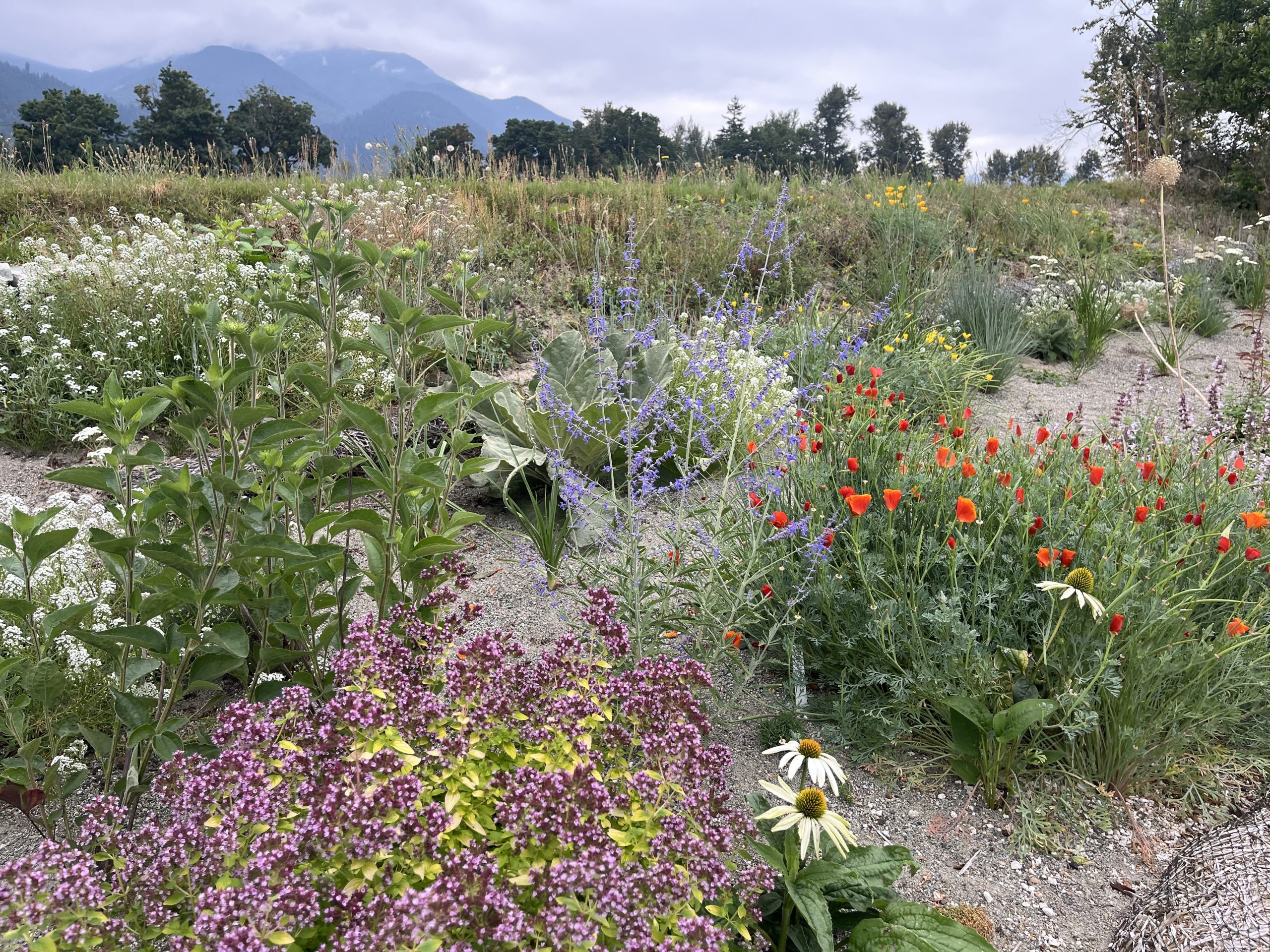
Design Process
I should note that picking plants is something that happens quite far along in my design process. It comes after several meetings with all of the human stakeholders in a project. After I've visited the site, done some hands on investigation and digital detective work. I like to gather as much information on a site and the reasons propelling the project as possible (to a high level of nerdiness). I need to know all of the basics like soil types, climate and hydrology but I also want to know it's history of use, any cultural considerations and/or special connections that the local population may appreciate. What feeling the finished project is meant to convey. What wildlife and plants are already using it, or should be using it. And, what materials are available; nearby, or onsite that could be utilized (including waste materials). If the area is prone to events, like wildfires or flooding. If there are green belts or spaces that it could connect to. And, of course what resources are available to maintain it (human and otherwise).
This is all in addition to local perimeters of course. Including all zoning, bylaws and safety regulations that may apply. Plus, any environmental or archaeological studies required. Not to mention interdisciplinary team members that may need to be brought in to a project (construction, specialized builds or consultants etc). All dependant on the scope, scale and needs of the individual job.
Once collected, I try to let all of this information percolate in the back of my mind and trust that ideas will start to pop up. And even as the doodles in my sketchbook begin, I like to let the thoughts sit for a few days if possible. It always feels like my brain will come up with an even better thought if I give it some space (and trust). Many times, an idea that seems impractical can become doable if you can find the right logistics, so don't dismiss a vision if it keeps coming back to you. Let it sit, jot it down in your phone or a notebook (so you don't forget it), do some research and see if it's possible.
For me, there's always a seed to begin from, a thought that feels right for the project and space. It could be a colour, material or vibe that acts as a starting point. Then the lists and rough drawings start, the mood boards and planning kicks into gear.

Site Specific Notes
Each of Virens Studio's planting and landscape plans are made specific to the project. Every site has it's own set of perimeters, needs, history and of course stakeholders. The following few sections are a long-story-short version of my findings for, the Sand Garden.
For context, it's a space that is meant to be experimental but beautiful. Building on and testing the ideas of Peter Korn on the westcoast of Canada. A spot to trial plants and ideas for future projects (but still a functional garden next to a house). Please visit my earlier post to learn more about it's concept and construction.
General Info
The site is located on an island in the Fraser Valley that runs through southwestern Canada. The surrounding area is a meeting place of streams and springs that flow off the nearby mountains as they enter the mighty Fraser River. There is a mix of quarries, farms and cropland with grasslands and limited forest. Old ox bows have become a slough and riparian zones have be altered by diking.
The sites topsoil is fill that was used to raise the elevation to equal that of the dike. It's a clay loam with native sand and gravel layers underneath. So, although the drainage is ultimately good, it does pool when the groundwater level is high (winter).
The climate is moderate, situated between the mild wet coastline and dry interior of British Columbia. Average temperatures are between -3 and 24 degrees (C). We occasionally get snow but more often rain through the winter months. The site sees winds that are typically around 1-4km/h (out of the west in summer; east in winter). With full sun all day. So, not a lot of protection, although there a few well placed trees on the edges. And, of course this doesn't include the more extreme weather events that are increasing as of late.

History of the Land
It's always important to learn what you can about the history of the land that you're working on. Industrial or agricultural use for instance, could mean chemical contamination that needs to be addressed. Also, cultural connections like a historical event or continued use for the land should be noted. If say, red ochre is harvested for dye stuffs in the surrounding area, it's great to echo or play off of that colour in the project. Even a small gesture but it is a way of acknowledging those involved. Besides, history is fascinating, the deeper you dig into it, the better you'll understand everything.
The greater area where the Sand Garden is located has been stewarded by the Leq’á:mel First Nation for some 10,000 years prior to European contact. "Leq’á:mél, meaning the level place where people meet, was once one of the most popular trading stops in Stó:lō territory...Leq’á:mél was home to many of the longhouses, some recorded almost a kilometer long. Historically our affiliates were the Sumas, Scowlitz, Matsqui and Nooksack tribes". Here, traditional land management utilizes a wide range of sustainable agro-forestry practices with minimal-moderate alterations made to the landscape over the centuries.
The oldest written histories tell of a river margin that was home to a network of wetlands, streams and swamps. Where willow, sedge and cattail, alder, crab apple and cranberry co-existed in mixed scrubland. Lower elevations supported forests of mixed conifer and western red cedar. While higher grounds were covered in alder and cottonwood. All areas experienced frequent disturbance due to seasonal flooding, debris build up and prescribed burning. In 1875, a steamboat passenger noted, "These trees in many places have preserved a great uniformity in growth, fringing the river like a gigantic hedge."
Although the Spanish had some early contact with the indigenous population, it was in the mid 1800's that European explorers began establishing trade routes, forts and settlements up and down the river.
One man, James Codville, took possession of 480 acres of land on the island in 1865. Quickly converting native grasslands into hay production and adding livestock, ferry services and a hotel. The proximity to the Fraser River and those travelling north along it (during the Gold Rush) meant that The Landing fast became a steam wheeler stopping point, mail and supply drop. The landmass was then split between two European men. McDonald, who took over the Codville property in the west and Deroche, who laid claim to the eastern section. Deroche in particular then spent 20 years clearing the land for cropping. But by the 1890's only 6% of the island had been cleared (72% being woodland, and 22% swamp/pasture).
Mapping and surveying meant that smaller parcels could then be bought and sold. While the Indian Act confined the Leq’á:mél population to Reserve lands that started out as large tracts but later became much reduced.
Construction of the railway nearby, drove industrialization. With logging, milling and quarries employing many. And dairy production and farming (hay, corn and blueberries) providing food stuffs. Modern dikes and a highway were constructed in the 1930's, reducing the waterway on northern side of the island to a slow moving slough.

Today
Today, 80% of the island is cultivated with the remainder a mix of residential, forested and/or protected nature reserve. Including Skweahm (IR #10), held by Leq’á:mel First Nations.
The greater area is considered an interface zone, where development meets wilderness. Wildfires are rare but concerning and large scale flooding still a possibility (especially during the seasonal freshet).
The unique ecological niches here make it one of the most biodiverse areas in western Canada. With the riparian zones that fringe the waterways considered threatened, endangered or lost due to development, silting of the slough, fertilizer contamination, blockages (pump stations) and more.
All of these details, get added to my notes. Along with a chart of any wildlife surveys that I could find and habitat remarks that will further inform any plant choices or design elements.

This is where it's also helpful to consult any local groups and people in my network that are experts in various subjects. And, when I say that I consider all of the stakeholders, I also include the local fauna and flora (with a special interest paid to endangered or threatened wildlife and plants). Plus anyone and everyone that could use or be effected by the use of the space (again a tall order, but it helps me sleep at night).
At this point, (depending on the scale and type of project) I usually look into local conservation (river, wetlands and ecology) groups and community members (farmers, schools, arts and culture, gardening, special needs and horticultural therapy practitioners etc) that may have added information or opinions to include. Social media and emails are great for this. They make it easy to reach out and ask any questions that can be answered as the other person's schedule allows.

Wish List
While we're getting a good holistic feeling for things, I create a plant wish list. I don't limit myself, or edit it right away. I just note plants that could work, in a general sense. It could be something that I've used before with success or have always wanted to use. A suggestion from a friend, colleague, books or even social media. The wish list is usually jotted down, along with any notes (good fall colour, tall and stately, seedheads etc) next to my research and site doodles. Eventually I build an excel chart (or a few). That helps me to compile lots of information on each plant all in one spot. I Also play with plant pallets, searching out images of each plant and trying out different combinations.
I like multipurpose materials. So, I look for plants that tick a lot of boxes. They should work environmentally, ecologically and aesthetically, economically, culturally and also be inclusive if possible. Since a single plant can't possibly do all of this on it's own, I seek out groups plants that can work together building a strong community. Different types of root structures, plant heights, survival strategies and eco services that are supported by the site conditions are ideal.
My goal is always to tap into any skill, experience or knowledge that I have to make the best choices that I can. But, don't be led astray, there is no perfection here. It's more about finding the best starting point that you can and then being flexible enough to pivot and adapt as needed. It's a bit like committing a great piece of music to memory and then improvising a new solo each night. It may not kill every time, but you will learn what works and what doesn't and revel in the successes, small and large.
Chart Time
My charts include plant names (both common and binomial because a 'bluebell' is never just a 'bluebell'). Plus, height and spread colour, bloom time, habitat value and ecosystem. I also include bullet points on wildlife interactions (as specific as possible, I try to get scientific surveys if possible). For example, whether a plant is a keystone species, a generalist that is valued by many species or a specialist that can service a single but important species. Because, when you're building a novel ecosystem you are looking for plants that will work together to tick all of those boxes and functions that we're looking for.
We do want plants that have an array of survival strategies and systems adapted to meet the conditions that are present at the site (today, as well as in the years to come). This kind of diversity is strength, it's what makes a planting resilient and better able to adapt to changing conditions over time.
I should note that my personal strategy is not to limit my plant picks in any way (to say, natives only), but rather to seek out the most functional material that I can get. For instance, white yarrow (Achillea millefolium) is indigenous to this area, but I'm willing to switch it out for a different coloured cultivar as long as it's the same species and not overly hybridized (for instance, a double flower that may inhibit pollinators). I'll also include some species that don't normally grow here but still have valuable functions. Like an Echinacea that comes from the prairies (thousands of kms away). Which fits the desired feeling, provides loads of eco services and is well suited to the expected (drier) future conditions than others.

Availability & Lead Times
As the list gets longer, I start to match it with what is actually available to me. Because you can dream about whatever plants you want (and there are thousands that are amazing), but if you can't source it somewhere then don't bother. Here's where the excel chart starts to really shine.
One of the most important columns is, 'source'. Can I get live plants, bare root or plugs, bulbs or seed for each species that I'm considering. If so I note, who, where and when on my list.
PSA, Plants Don't Care When You Want to Plant a Garden
Don't be fooled, plants are seasonal and not available at all times of the year. Bulbs for instance, are planted in the fall for blooms the following spring. But, they are actually ordered in June. So, you need to decide on (and order) them a full 3/4s of a year before they flower in the garden.
many perennials, especially those grown on site (and without chemicals) at your local nursery, take months to reproduce and grown on. So, be warned that if you want large quantities or special items, you need to contact the grower and order early.
The same goes for bare root and some seeds that are available for growing only at certain times of the year.
C-S-R
One column that you may not recognize is, 'C-S-R' value. It's a handy system that helps you to organize plants by their survival strategies (C=competitor, S=stress tolerator and R=ruderal) . Now this may sound a bit weird, but once you get the hang of it, it really works.
Competitors, do best where there are abundant resources and low disturbance. They survive through rapid growth and larger size, out competing other species and living long lives.
Stress Tolerators, have adapted to stressors like low nutrient availability or drought with low disturbance. They can survive stressful events through specific resilient traits (like going dormant in heat).
While, Ruderals are able to withstand disturbance in areas with relatively high resources. They rely on rapid growth, short lifespans and efficient reproduction characteristics (like high seed rates) for survival.
A plants C-S-R value is usually visualized using a (Grimes) triangle, where each corner represents a strategy. And, the interior of the triangle a range in between each. You'll see that some plants are a CS, a CR or maybe an SR. Where a plant sits can be subjective, so feel free to make your own placements. Die Staudengartëuerei's website has a great search tool that includes C-S-R values. You can either look for individual plants by name and find the corresponding C-S-R information or browse for plant lists by C-S-R strategy type.

Next Steps
,Once the research, planning and charts are done, the plants ordered and the design completed, then comes construction, planting and installation. But before you hit those next steps, it's ok to take a breath. It can be a long process but I promise you, it's worth the effort. So, try to take your time (as much as budgets and deadlines will allow), enjoy the work and have a bit of fun everyday. Greenspaces, plants and wildlife are all import ways to add value to life (be it through an up tick in property value, peace of mind or a health boost for you and the planet, it matters!
Sara-Jane @ Virens Studio & Hedgecraft Willow
Virens is a Studio, located near Vancouver, Canada that specializes in eco landscape and planting design.
Hedgecraft Willow grows and sells live and dried willow rods for craft and building in the Fraser Valley of Canada.
© Virens Studio 2025 (all photos are used for demonstration purposes and do not necessarily belong to us.)
What’s a life lived without any vices, dirt or messiness? I might reply, boring. Because, when I think about it, what’s more interesting to witness and be a part of? Think of a classy soirée. Where everyone arrives dressed to impress, with manners to match. On their best behaviour, that is, until late into the…
Are You a Lazy Gardener? Or, a Habitat Hero?

I see people slowing down for a good long look at my new garden. And as I clock their movements, in my mind I can hear them saying, “what kind of landscaping is that?, the plants are all soooo small and what’s with all the sand?!” Well, as a planting designer, former parks gardener and…
The Sand Garden: A New Experiment Begins

Inspiration During a recent coffee house meet up with a new friend, Stephanie Aitken (a landscape consultant with Urban Systems, Kelowna), something occurred to me. That although both Stephanie and I work in different areas of the province, each with unique plant life, climates and history of place, we have a lot in common. As…
A New Idea to Inspire Eco-friendly City Landscape Practices